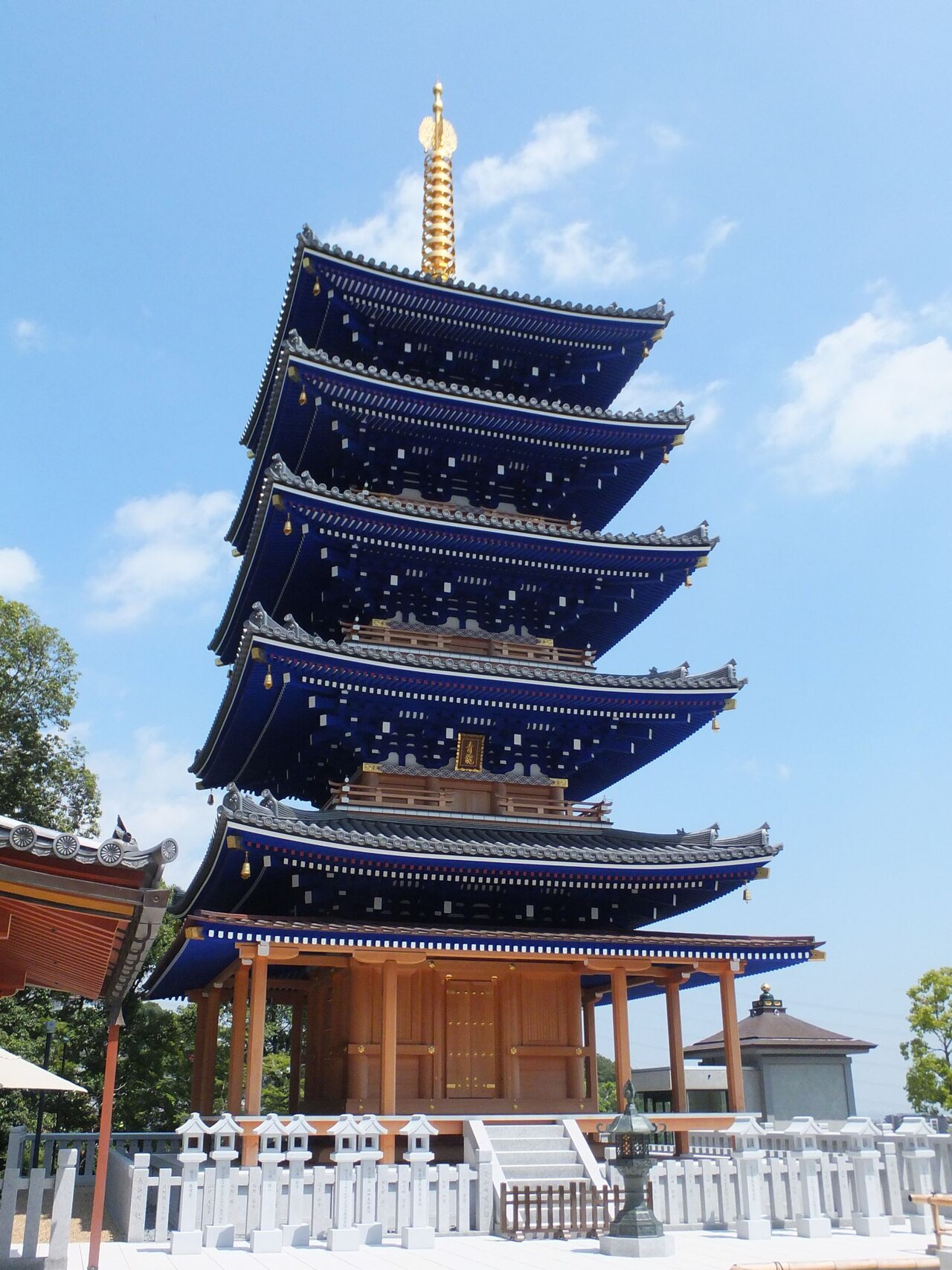
Nakayamadera Temple
Nakayama-dera · Nakayamadera · 中山寺
overview
What this place is
Nakayamadera in Takarazuka, Hyogo Prefecture, is the twenty-fourth stop on the Saigoku thirty-three Kannon pilgrimage and stands about a minute on foot from Nakayama-Kannon Station. Its principal image is the eleven-headed Kannon, a hidden image opened to view on the eighteenth of each month. The temple relates that Prince Shotoku founded it, and its five-storey Seiryuto pagoda, rebuilt in 2017 in deep blue, stands about 28 metres high.
- The Seiryuto, a wooden five-storey pagoda in deep blue rebuilt in 2017, about 28 metres high
- A principal image opened to view on the eighteenth of each month
- Escalators and a lift within the grounds, running from 9:00 to 16:30
- The Okunoin, about two kilometres by mountain path north-west of the main hall
plan your visit
Visit facts for Nakayamadera Temple
- Access
- About 175 minutes from Tokyo Station by Shinkansen to Shin-Osaka and on by JR and Hankyu lines to Nakayama-Kannon Station, then about 1 minute on foot north. From Hankyu Osaka-Umeda the journey to the station takes about 30 minutes.
- Nearest station
- Nakayama-Kannon Station (Hankyu Takarazuka Line)
- Hours
- The mountain gate does not close, but the desks are open from 9:00 to 16:00 and the escalators and lift run from 9:00 to 16:30. Prayers for a safe birth are received from 9:00 to 16:00 and the special form until 15:30.
- Fees
- Entry is free. A prayer for a safe birth is 8,000 yen and the special form 20,000 yen. A prayer for conceiving a child is 5,000 yen for ten days, 8,000 yen for twenty days or 11,000 yen for a month.
- Parking
- Available in Japanese only: 公式は専用の駐車場・駐輪場がなく、周辺の私営駐車場または公共交通を利用するよう案内しています。山門付近は道幅が狭く車同士のすれ違いが難しいため、送迎の停車、満車待ち、路上駐車をせず、祈祷・戌の日・星下りの交通条件を直前確認します。
- Goshuin (seal stamps)
- A goshuin is given as a record of your visit, and limited designs appear for particular years and for the Hoshikudari rite on 9 August. Check the current arrangements at the desk.
- Typical visit
- About 90 minutes (Unmeguri's estimate, not an official figure)
- Facts checked
- 2026-10-22
background
Principal image
Eleven-headed Kannon
The principal image is the eleven-headed Kannon. The temple relates that Queen Shrimala of ancient India made a vow to save women and carved the image in her own likeness, and that it came to Japan by way of three countries. The faith in safe birth and in conceiving a child is the religious tradition of the temple, not an assurance about pregnancy, tests, delivery or treatment.
etiquette
Visiting with respect
- Do not touch, climb or lean on the pagoda, the walls, the lanterns, the tiles, the steps, the images or the maternity sashes, and follow the railings and the guidance on photography.
- A prayer for a safe birth does not take the place of antenatal checks, a diagnosis, treatment, medication, rest or an emergency call.
- Do not treat difficulty, loneliness or the changes of pregnancy as a want of faith; speak to your doctor, your midwife or the support services near you.
- The day of the dog, the fifth month, attending in person and a long visit are not required: the temple states that other days, a visit on someone’s behalf and an application by post are all possible.
- Do not read the sex, the health or the delivery date of a child from a sash, an amulet, a goshuin or a fortune.
- A prayer for conceiving a child is not an assurance about fertility treatment, nor a duty, nor a measure of anyone’s worth; continuing, pausing, stopping or choosing not to have a child are the visitor’s own decisions.
- The escalators and lift do not mean the whole of the grounds can be reached in a wheelchair; check the current route and ask the staff.
- The Okunoin is about two kilometres by mountain path; check your shoes, water, the weather and the light, and do not drink the spring water untreated.
- Hours, fees and reception can change; check the official information before you go.
faq
Common questions
How do I get to Nakayamadera Temple?
About 175 minutes from Tokyo Station by Shinkansen to Shin-Osaka and on by JR and Hankyu lines to Nakayama-Kannon Station, then about 1 minute on foot north. From Hankyu Osaka-Umeda the journey to the station takes about 30 minutes. Nearest station: Nakayama-Kannon Station (Hankyu Takarazuka Line).
How much does it cost to visit Nakayamadera Temple?
Entry is free. A prayer for a safe birth is 8,000 yen and the special form 20,000 yen. A prayer for conceiving a child is 5,000 yen for ten days, 8,000 yen for twenty days or 11,000 yen for a month.
What are the opening hours of Nakayamadera Temple?
The mountain gate does not close, but the desks are open from 9:00 to 16:00 and the escalators and lift run from 9:00 to 16:30. Prayers for a safe birth are received from 9:00 to 16:00 and the special form until 15:30.
Is there parking at Nakayamadera Temple?
Parking information for Nakayamadera Temple is available in Japanese only: 公式は専用の駐車場・駐輪場がなく、周辺の私営駐車場または公共交通を利用するよう案内しています。山門付近は道幅が狭く車同士のすれ違いが難しいため、送迎の停車、満車待ち、路上駐車をせず、祈祷・戌の日・星下りの交通条件を直前確認します。
How long should I spend at Nakayamadera Temple?
Unmeguri's estimate for a visit is about 90 minutes. This is an editorial estimate, not an official figure.
Can I get a goshuin at Nakayamadera Temple?
A goshuin is given as a record of your visit, and limited designs appear for particular years and for the Hoshikudari rite on 9 August. Check the current arrangements at the desk.
Can I see the principal image?
It is a hidden image, opened to view on the eighteenth of each month. On other days the halls and the pagoda can be visited as usual.
sources
Sources and checked dates
- 大本山 中山寺 公式サイト(opens in a new tab)
- 中山寺について(opens in a new tab)
- 中山寺の歴史(opens in a new tab)
- 安産の観音さま(opens in a new tab)
- アクセス|中山寺(opens in a new tab)
- よくあるご質問|中山寺(opens in a new tab)
- ご祈祷|中山寺(opens in a new tab)
- 安産祈願|中山寺(opens in a new tab)
- 子授け祈願|中山寺(opens in a new tab)
- 鳥瞰図・境内案内|中山寺(opens in a new tab)
- 堂塔伽藍・五重塔|中山寺(opens in a new tab)
- 堂塔伽藍・奥之院|中山寺(opens in a new tab)
- 星下り大会式|中山寺(opens in a new tab)
- 令和8年限定朱印のご案内|中山寺(opens in a new tab)
- 妊婦健診の検査|こども家庭庁(opens in a new tab)
Facts last checked on 2026-10-22. Sources are in Japanese. Unmeguri separates officially documented facts from its own editorial reading, and does not promise that any wish or outcome will be realized.