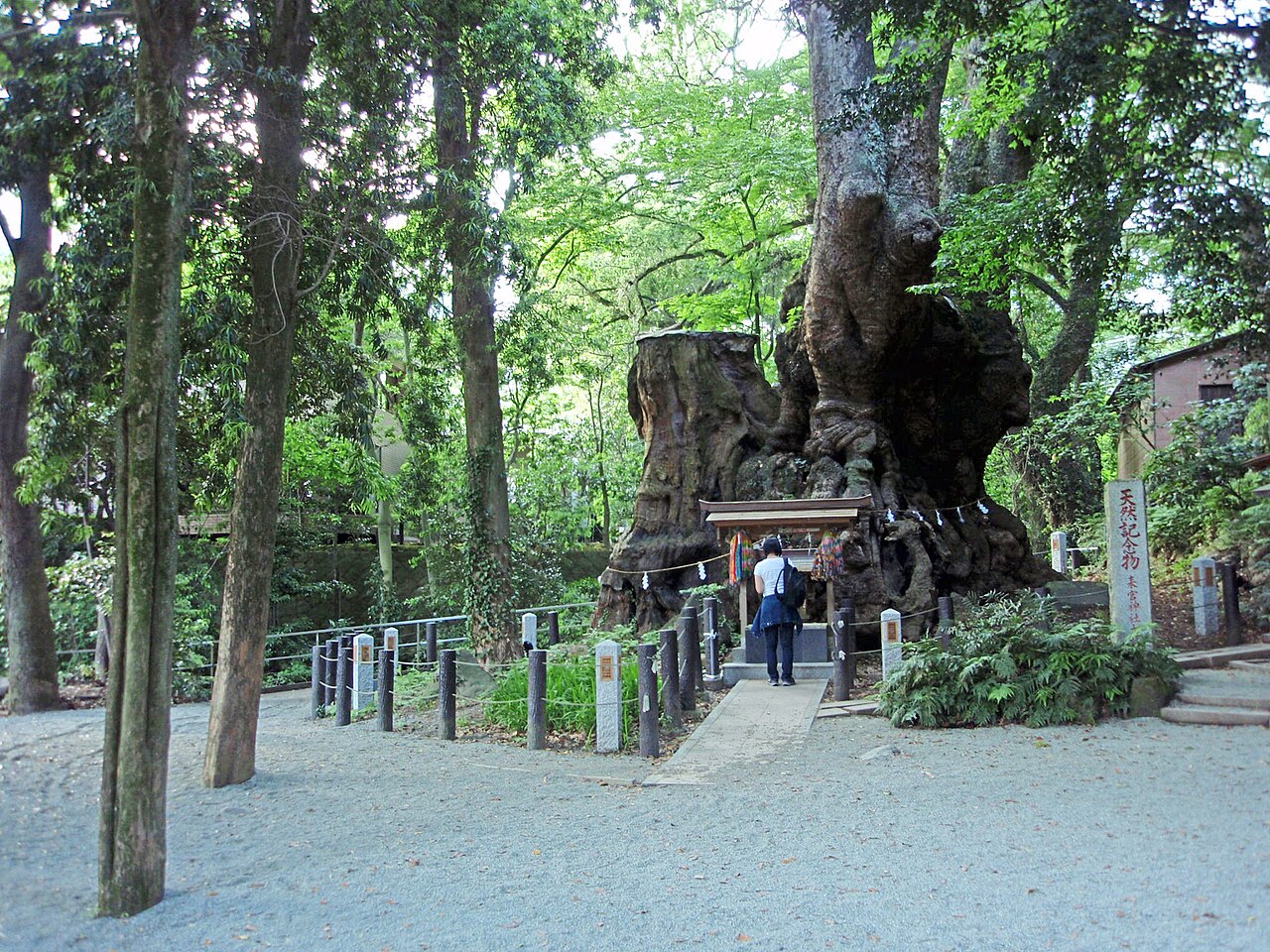
Kinomiya Shrine
Kinomiya Jinja · Kinomiya-jinja · 來宮神社
overview
What this place is
Kinomiya Shrine stands about five minutes on foot from Kinomiya Station in Atami, Shizuoka Prefecture. It enshrines Yamato Takeru-no-Mikoto, Isotakeru-no-Mikoto and Onamuchi-no-Mikoto. By its history, in 710 a wooden image was caught in a net in Atami Bay and Isotakeru-no-Mikoto, appearing as a child, asked to be enshrined in a hollow of seven camphor trees where the waves could not be heard. The First Great Camphor in the grounds is a national natural monument.
- The First Great Camphor, described by the shrine as over 2,100 years old with a trunk about 24 metres round
- The Second Great Camphor near the entrance, which still puts out leaves after losing most of its trunk to lightning
- A precinct of greenery and water, with an evening illumination around the great trees
- A tradition of prayers for giving something up, including alcohol
plan your visit
Visit facts for Kinomiya Shrine
- Access
- About 50 minutes from Tokyo Station by the Tokaido Shinkansen to Atami Station and the JR Ito Line to Kinomiya Station, then about 5 minutes on foot. From Atami Station it is about 18 minutes on foot or about 20 minutes by bus.
- Nearest station
- Kinomiya Station (JR Ito Line)
- Hours
- The shrine gives its hours as 9:00 to 17:00, with prayer reception until 16:30. Work on the ceiling of the worship hall finished early and prayers and weddings resumed there on 2 July 2026, but notices about the works remain, so follow the signs and staff on the day.
- Fees
- Ordinary worship is free. Reception for a prayer service is in cash only and the current amount is not published; the amulet against drink and the camphor bark amulet are 800 yen each and the camphor votive tablet 1,000 yen.
- Parking
- Available in Japanese only: 駐車場は2022年12月から有料で台数に限りがあり、祈祷者・通常参拝者とも予約できません。土日祝日や祭礼時は提携駐車場へ案内できない場合があり、公式は公共交通または来宮駅前市営駐車場の利用を勧めています。正月は駐車場ごとに閉鎖・無料開放時刻が変わるため、その年の公式表と誘導員の指示を優先します。
- Goshuin (seal stamps)
- A goshuin is given as a record of your visit. The shrine does not publish fixed reception hours or an amount for it, so confirm on the day; reception can pause during rites.
- Typical visit
- About 75 minutes (Unmeguri's estimate, not an official figure)
- Facts checked
- 2026-10-22
background
Enshrined deities
Yamato Takeru-no-Mikoto · Isotakeru-no-Mikoto · Onamuchi-no-Mikoto
The shrine describes Yamato Takeru-no-Mikoto in connection with courage and decision, Isotakeru-no-Mikoto with trees and the care of nature, and Onamuchi-no-Mikoto with prosperity in business and bodily strength. The faith here takes a tree as the place where the deity is received.
etiquette
Visiting with respect
- The Second Great Camphor lost most of the inside of its trunk to lightning; the shrine warns that going round the back and touching it will blacken your clothes. Do not enter the hollow or reach into it.
- Walking once round the First Great Camphor is an optional practice, not something a visit requires; worship from the front is complete in itself.
- Do not touch the roots, the trunk, the rope, the fences or the lighting equipment, and do not stop on the circular path in a way that blocks others.
- A prayer for giving up alcohol does not take the place of medical care. If you have tremors, sweating or palpitations, or are anxious about stopping suddenly, speak to a doctor or a specialist service first.
- The shrine states that a prayer to give up drink requires the person concerned to attend; do not have someone else pledge on their behalf.
- The main festival runs from 14 to 16 July each year, when the usual timings, parking and access to the great camphor do not apply.
- Hours, fees and reception can change; check the official information before you go.
faq
Common questions
How do I get to Kinomiya Shrine?
About 50 minutes from Tokyo Station by the Tokaido Shinkansen to Atami Station and the JR Ito Line to Kinomiya Station, then about 5 minutes on foot. From Atami Station it is about 18 minutes on foot or about 20 minutes by bus. Nearest station: Kinomiya Station (JR Ito Line).
How much does it cost to visit Kinomiya Shrine?
Ordinary worship is free. Reception for a prayer service is in cash only and the current amount is not published; the amulet against drink and the camphor bark amulet are 800 yen each and the camphor votive tablet 1,000 yen.
What are the opening hours of Kinomiya Shrine?
The shrine gives its hours as 9:00 to 17:00, with prayer reception until 16:30. Work on the ceiling of the worship hall finished early and prayers and weddings resumed there on 2 July 2026, but notices about the works remain, so follow the signs and staff on the day.
Is there parking at Kinomiya Shrine?
Parking information for Kinomiya Shrine is available in Japanese only: 駐車場は2022年12月から有料で台数に限りがあり、祈祷者・通常参拝者とも予約できません。土日祝日や祭礼時は提携駐車場へ案内できない場合があり、公式は公共交通または来宮駅前市営駐車場の利用を勧めています。正月は駐車場ごとに閉鎖・無料開放時刻が変わるため、その年の公式表と誘導員の指示を優先します。
How long should I spend at Kinomiya Shrine?
Unmeguri's estimate for a visit is about 75 minutes. This is an editorial estimate, not an official figure.
Can I get a goshuin at Kinomiya Shrine?
A goshuin is given as a record of your visit. The shrine does not publish fixed reception hours or an amount for it, so confirm on the day; reception can pause during rites.
Do I have to walk around the great camphor?
No. The tradition of walking once round it is optional. If the grounds are busy, or if you use a wheelchair or a stick, worship from the front is a complete visit.
sources
Sources and checked dates
- 御祭神縁起|來宮神社(opens in a new tab)
- 大楠|來宮神社(opens in a new tab)
- 境内図|來宮神社(opens in a new tab)
- 御祈祷や外祭|來宮神社(opens in a new tab)
- お申込み・お問合せ|來宮神社(opens in a new tab)
- 授与品(お守り・お札・他)|來宮神社(opens in a new tab)
- お砂、お水(お水取り)|來宮神社(opens in a new tab)
- アクセス・交通|來宮神社(opens in a new tab)
- 令和8年度 來宮神社拝殿 天井改修工事に伴うお知らせ|來宮神社(opens in a new tab)
- 熱海 來宮神社(opens in a new tab)
- 例大祭|來宮神社(opens in a new tab)
- 熱海の伝統工芸品「熱海楠細工」|熱海市(opens in a new tab)
- アルコール健康障害対策|厚生労働省(opens in a new tab)
Facts last checked on 2026-10-22. Sources are in Japanese. Unmeguri separates officially documented facts from its own editorial reading, and does not promise that any wish or outcome will be realized.