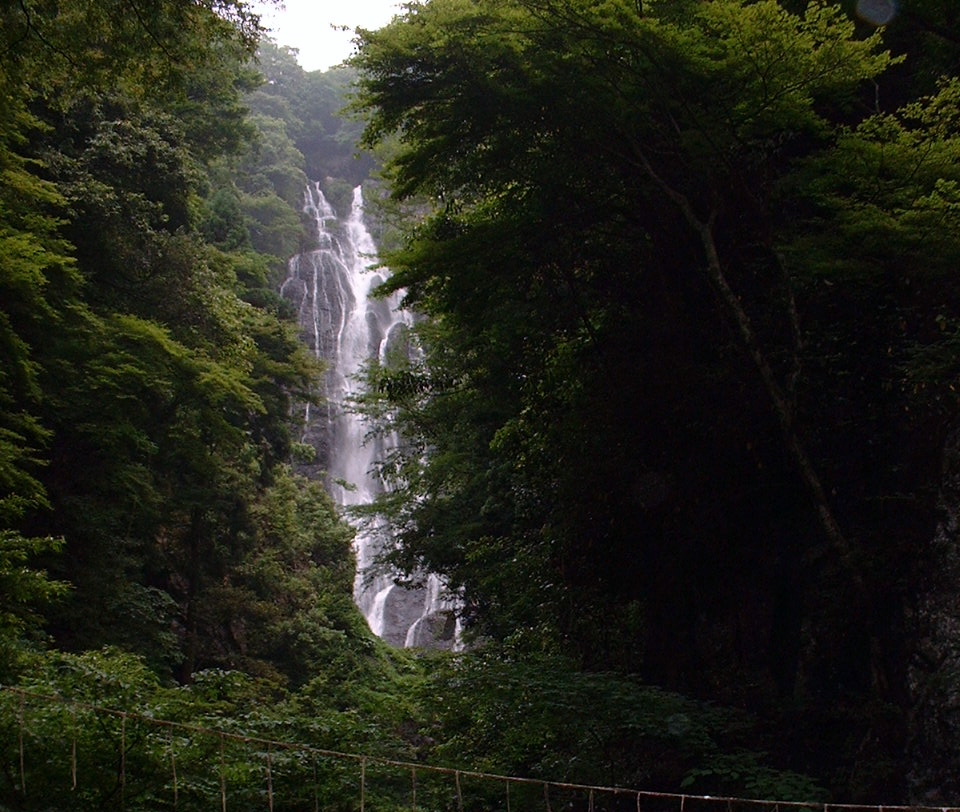
Kanba Falls
Kanba-no-taki · Kanba Falls Nature Park · 神庭の滝
overview
What this place is
Kanba Falls in Maniwa is a stepped fall given by the city as 110 metres high and 20 metres wide, with a black rock at its centre likened to a carp climbing against the current. It was designated a national place of scenic beauty on 8 July 1930 and is one of Japan’s hundred selected waterfalls. Wild Japanese macaques live in the park, and the distance kept from them is part of visiting.
- A stepped fall given as 110 metres high and 20 metres wide
- The carp rock at the centre of the fall
- Tamadare Falls downstream, named for water like eaves-drip on a thatched roof
- Wild Japanese macaques, studied here since 1958
plan your visit
Visit facts for Kanba Falls
- Access
- About 345 minutes from Tokyo Station by Shinkansen to Okayama and the JR Tsuyama and Kishin lines to Chugoku-Katsuyama Station, then by taxi. The tourism board gives about 10 minutes and roughly 2,000 yen one way, the prefecture about 20 minutes; the two do not agree, so confirm and secure the way back before you enter.
- Nearest station
- Chugoku-Katsuyama Station (JR Kishin Line)
- Hours
- 8:30 to 17:15, last entry 16:30, closed 29 December to 3 January. The city states the park may close without notice in heavy snow or rain, and the by-law allows entry to be limited when a warning is out. Even within opening hours, the paths, the viewpoints, the cave and the presence of the macaques are not assured.
- Fees
- From 1 April 2026, for visitors from outside Maniwa, 600 yen for adults and 300 yen for primary and junior-high pupils; for groups of twenty or more, 360 yen and 180 yen. Residents of Maniwa and holders of the relevant disability certificate pay half. Parking is free. Do not use the older 300 yen and 150 yen shown on old maps.
- Parking
- Available in Japanese only: 真庭市公式は無料駐車場を普通車75台、車いすマーク2台、バス3台、二輪6台と案内し、真庭観光局は普通車77台と案内します。普通車75台に車いす区画2台を加えた表記かは断定せず、満空、区画、冬期、大雨・大雪、紅葉期の運用を当日確認します。路上、橋、園路入口、バス・二輪区画で待機・乗降・撮影をしません。
- Typical visit
- About 90 minutes (Unmeguri's estimate, not an official figure)
- Facts checked
- 2026-10-22
background
Central feature
Kanba Falls and the carp rock · Tamadare Falls and the Kanba river valley · the wild macaques, kept at a distance from people
This is not a shrine or a temple but a nature park run by the city of Maniwa for the landscape, the environment and visitors. The official information consulted gives no deity, no principal image, no form of worship and no claim about health. Treat it as a visit to be managed by your own stamina, by watching, by the boundary set for conservation and by the way back.
etiquette
Visiting with respect
- Wheelchairs are lent at the lowest souvenir shop opposite the car park and at the ticket office, and the city says a point where the falls are visible can be reached; it is about 300 metres from the car park to the office and about 200 more to that point, on a continuous slope, so someone to push is likely to be needed.
- The car park, the ticket office, the point where the falls are visible and any route without steps are separate destinations.
- The macaques are wild; do not feed them, approach them or leave food out. The research going on here is not permission to feed them.
- The old designation records a different height and width from the current figures; do not mix the two.
- Take nothing from the valley and carry out what you bring in.
- Hours, fees and reception can change; check the official information before you go.
faq
Common questions
How do I get to Kanba Falls?
About 345 minutes from Tokyo Station by Shinkansen to Okayama and the JR Tsuyama and Kishin lines to Chugoku-Katsuyama Station, then by taxi. The tourism board gives about 10 minutes and roughly 2,000 yen one way, the prefecture about 20 minutes; the two do not agree, so confirm and secure the way back before you enter. Nearest station: Chugoku-Katsuyama Station (JR Kishin Line).
How much does it cost to visit Kanba Falls?
From 1 April 2026, for visitors from outside Maniwa, 600 yen for adults and 300 yen for primary and junior-high pupils; for groups of twenty or more, 360 yen and 180 yen. Residents of Maniwa and holders of the relevant disability certificate pay half. Parking is free. Do not use the older 300 yen and 150 yen shown on old maps.
What are the opening hours of Kanba Falls?
8:30 to 17:15, last entry 16:30, closed 29 December to 3 January. The city states the park may close without notice in heavy snow or rain, and the by-law allows entry to be limited when a warning is out. Even within opening hours, the paths, the viewpoints, the cave and the presence of the macaques are not assured.
Is there parking at Kanba Falls?
Parking information for Kanba Falls is available in Japanese only: 真庭市公式は無料駐車場を普通車75台、車いすマーク2台、バス3台、二輪6台と案内し、真庭観光局は普通車77台と案内します。普通車75台に車いす区画2台を加えた表記かは断定せず、満空、区画、冬期、大雨・大雪、紅葉期の運用を当日確認します。路上、橋、園路入口、バス・二輪区画で待機・乗降・撮影をしません。
How long should I spend at Kanba Falls?
Unmeguri's estimate for a visit is about 90 minutes. This is an editorial estimate, not an official figure.
How high are the falls?
The city gives 110 metres high and 20 metres wide. The 1930 designation records different figures, which are not mixed with these.
Are there monkeys?
Wild Japanese macaques live here, but their presence is not assured. Do not feed or approach them.
sources
Sources and checked dates
- 神庭の滝・現行料金・開園・駐車・野猿・臨時休園|真庭市(opens in a new tab)
- 真庭市神庭の滝自然公園条例(opens in a new tab)
- 園路・橋・勾配・鬼の穴・展望地点|神庭の滝自然公園案内図(opens in a new tab)
- 車いす貸出・距離・勾配|真庭市FAQ(opens in a new tab)
- ペット同伴不可|真庭市FAQ(opens in a new tab)
- 野生のサルの出現時期・当日確認|真庭市FAQ(opens in a new tab)
- 1分ごとの現地画像・当日問い合わせ|真庭市ライブカメラ(opens in a new tab)
- 交通・料金・障害者割引・運営管理|真庭観光局(opens in a new tab)
- 段瀑・遊歩道・交通・駐車|岡山県公式観光(opens in a new tab)
- 国指定名勝 神庭瀑・指定日・旧解説|文化庁(opens in a new tab)
- 鯉岩・玉垂の滝・渓谷林・野猿|観光庁多言語解説(opens in a new tab)
- 1958年からの勝山ニホンザル集団研究|大阪大学(opens in a new tab)
- ニホンザルとの距離・目線・餌付け防止|岡山県(opens in a new tab)
- 自然水域の増水・滑り・子どもの水難防止|こども家庭庁(opens in a new tab)
- 雨後の滑り・撮影・落石・沢の安全|林野庁(opens in a new tab)
- 滝写真・撮影日時・作者・ライセンス|Wikimedia Commons(opens in a new tab)
Facts last checked on 2026-10-22. Sources are in Japanese. Unmeguri separates officially documented facts from its own editorial reading, and does not promise that any wish or outcome will be realized.