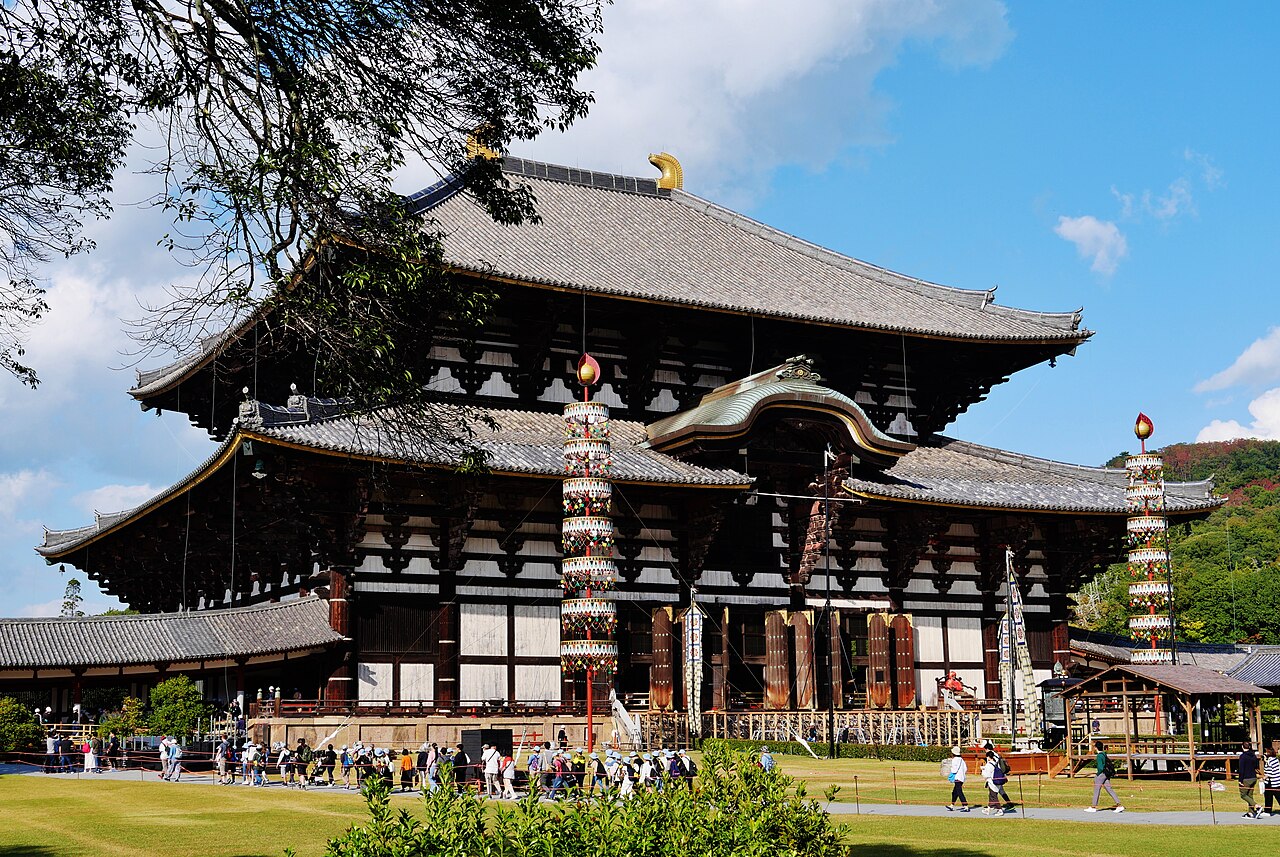
Todai-ji Temple
東大寺 · Todaiji · Great Buddha of Nara
overview
What this place is
Todai-ji is the head temple of the Kegon school of Buddhism in Nara, home of the Great Buddha of Nara. Emperor Shomu issued the vow to create the colossal Rushana Buddha in 743, praying that all living things might flourish together, and the eye-opening ceremony was held in 752 after years of casting. Twice ravaged by war fires, the Great Buddha Hall was last rebuilt in 1709 at a reduced width, and the temple honors four sages — Emperor Shomu, Gyoki, Roben, and Bodhisena — together with the countless people whose work realized the project.
- The Great Buddha, the National Treasure Rushana Buddha, cast by 749 after eight castings over three years and consecrated in 752
- The Great Buddha Hall of 1709, rebuilt at a reduced east–west width and reinforced with steel between 1906 and 1912
- The Nigatsudo hall, open around the clock, with the Hokkedo and the Kaidando in the eastern precinct
- A founding history that credits four sages and the cooperation of great numbers of ordinary people
plan your visit
Visit facts for Todai-ji Temple
- Access
- From Kintetsu Nara Station, take the city loop bus to the Todaiji Daibutsuden–Kasuga Taisha-mae stop and walk about 5 minutes, according to the official guide, or walk about 20 minutes from the station. The Gurutto Bus stops at the Daibutsuden-mae parking lot, right by the approach.
- Nearest station
- Todaiji Daibutsuden–Kasuga Taisha-mae bus stop (from Kintetsu Nara Station)
- Hours
- The Great Buddha Hall is open 7:30 to 17:30 from April to October and 8:00 to 17:00 from November to March; the Hokkedo and the Kaidando are open 8:30 to 16:00. The Todaiji Museum opens 9:30 with last entry 30 minutes before closing, and is scheduled to close on August 24 and October 6 to 9, 2026 for exhibition changes. The Nigatsudo can be visited around the clock, with quiet asked at night.
- Fees
- The Great Buddha Hall, the Hokkedo, the Kaidando, and the Todaiji Museum each charge 800 yen for adults and 400 yen for elementary school students, cash only. A set ticket for the hall and museum is 1,200 yen for junior high school age and up and 600 yen for elementary school students, an audio guide is 500 yen, and goshuin are listed at 300 yen each.
- Parking
- Available in Japanese only: 東大寺に乗用車・観光バスの専用駐車場はありません。近隣の有料駐車場を利用し、繁忙期は公共交通を優先します。バイク・自転車は南大門南西の駐輪場へ置き、南大門〜大仏殿と大仏殿出入口前の参道へ進入しません。人や鹿との接触を避け、参道を横切る時は降りて押します。駐車待ち、送迎、タクシー降車で参道、バス停、横断歩道、鹿の移動、緊急車両動線を塞ぎません。
- Goshuin (seal stamps)
- The "Kegon" goshuin of the Great Buddha Hall is received at the hall, 7:30 to 17:30 from April to October and 8:00 to 17:00 from November to March, listed at 300 yen; pray first, and if the line is long, give priority to your return transport.
- Typical visit
- About 100 minutes (Unmeguri's estimate, not an official figure)
- Facts checked
- 2026-10-22
background
Principal image
Rushana Butsu (Vairocana Buddha), the Great Buddha of Nara
The temple explains that the principal image of the Great Buddha Hall is the National Treasure Rushana Buddha, a buddha whose light of wisdom and compassion shines on all things, and introduces the Kegon teaching that every existence — birdsong, the color of flowers, flowing water, drifting clouds — is boundlessly interconnected.
etiquette
Visiting with respect
- The deer around the approach are wild animals; do not tease or corner them, and keep food and paper out of their reach.
- Inside the Great Buddha Hall, follow the visitor route and the posted photography rules, and do not touch the statues or the pillars.
- At the halls, place a donation in the offering box, put your hands together quietly, and bow; unlike at a shrine, you do not clap at a temple.
- When visiting the Nigatsudo at night, keep quiet and keep to the open galleries and paths.
- Hours, fees and reception can change; check the official information before you go.
faq
Common questions
How do I get to Todai-ji Temple?
From Kintetsu Nara Station, take the city loop bus to the Todaiji Daibutsuden–Kasuga Taisha-mae stop and walk about 5 minutes, according to the official guide, or walk about 20 minutes from the station. The Gurutto Bus stops at the Daibutsuden-mae parking lot, right by the approach. Nearest station: Todaiji Daibutsuden–Kasuga Taisha-mae bus stop (from Kintetsu Nara Station).
How much does it cost to visit Todai-ji Temple?
The Great Buddha Hall, the Hokkedo, the Kaidando, and the Todaiji Museum each charge 800 yen for adults and 400 yen for elementary school students, cash only. A set ticket for the hall and museum is 1,200 yen for junior high school age and up and 600 yen for elementary school students, an audio guide is 500 yen, and goshuin are listed at 300 yen each.
What are the opening hours of Todai-ji Temple?
The Great Buddha Hall is open 7:30 to 17:30 from April to October and 8:00 to 17:00 from November to March; the Hokkedo and the Kaidando are open 8:30 to 16:00. The Todaiji Museum opens 9:30 with last entry 30 minutes before closing, and is scheduled to close on August 24 and October 6 to 9, 2026 for exhibition changes. The Nigatsudo can be visited around the clock, with quiet asked at night.
Is there parking at Todai-ji Temple?
Parking information for Todai-ji Temple is available in Japanese only: 東大寺に乗用車・観光バスの専用駐車場はありません。近隣の有料駐車場を利用し、繁忙期は公共交通を優先します。バイク・自転車は南大門南西の駐輪場へ置き、南大門〜大仏殿と大仏殿出入口前の参道へ進入しません。人や鹿との接触を避け、参道を横切る時は降りて押します。駐車待ち、送迎、タクシー降車で参道、バス停、横断歩道、鹿の移動、緊急車両動線を塞ぎません。
How long should I spend at Todai-ji Temple?
Unmeguri's estimate for a visit is about 100 minutes. This is an editorial estimate, not an official figure.
Can I get a goshuin at Todai-ji Temple?
The "Kegon" goshuin of the Great Buddha Hall is received at the hall, 7:30 to 17:30 from April to October and 8:00 to 17:00 from November to March, listed at 300 yen; pray first, and if the line is long, give priority to your return transport.
When was the Great Buddha made?
Emperor Shomu issued the vow in 743, the body of the statue was cast by 749 after eight castings over three years, and the eye-opening ceremony was held in 752. The present hall dates from a 1709 rebuilding.
sources
Sources and checked dates
- 拝観時間・料金・割引・音声ガイド|東大寺(opens in a new tab)
- 車いす・トイレ・鹿・大仏造立の詔|東大寺(opens in a new tab)
- 鉄道・バス・徒歩・駐輪・駐車|東大寺(opens in a new tab)
- 南大門・金剛力士像・復興|東大寺(opens in a new tab)
- 大仏殿・盧舎那仏・華厳・造営と再建|東大寺(opens in a new tab)
- 法華堂・不空羂索観音・法要・撮影|東大寺(opens in a new tab)
- 戒壇院戒壇堂・四天王像・撮影|東大寺(opens in a new tab)
- 二月堂・月例法要・夜間参拝・撮影|東大寺(opens in a new tab)
- ミュージアム展示・時間・料金・休館|東大寺(opens in a new tab)
- 各堂の御朱印・受付・終了情報|東大寺(opens in a new tab)
- 写経・写仏・指図堂・奉納料|東大寺(opens in a new tab)
- 年中行事・解除会・万灯供養会|東大寺(opens in a new tab)
- 2026年鹿の出産期の注意|東大寺(opens in a new tab)
- 交通・拝観・所要・文化財|奈良市観光協会(opens in a new tab)
Facts last checked on 2026-10-22. Sources are in Japanese. Unmeguri separates officially documented facts from its own editorial reading, and does not promise that any wish or outcome will be realized.