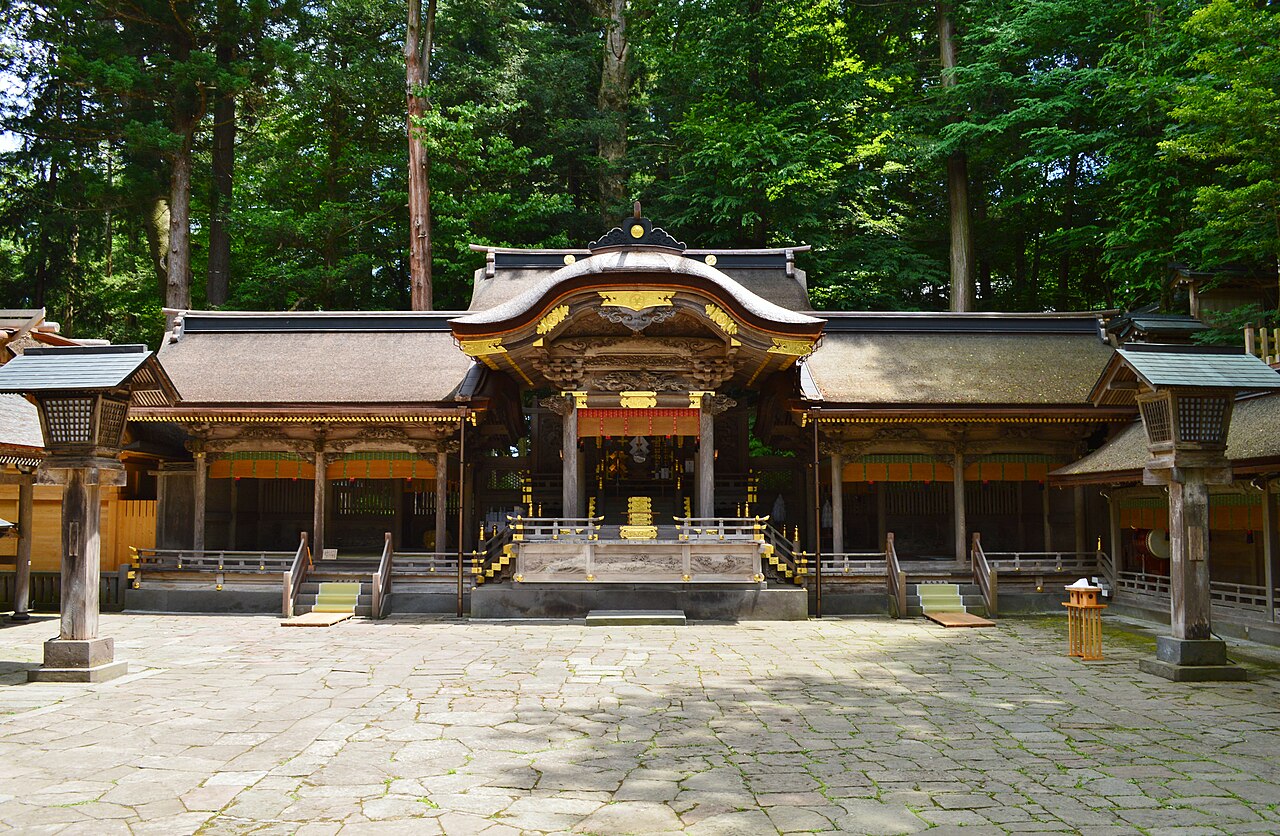
Suwa Taisha Kamisha Honmiya Shrine
Suwa Grand Shrine Kamisha Honmiya · Honmiya · 諏訪大社 上社本宮
overview
What this place is
Kamisha Honmiya in Suwa is one of the four shrines that together form Suwa Taisha, the head of the Suwa shrines across Japan and first shrine of Shinano province. It enshrines Takeminakata-no-Kami. There is no main hall: the mountain itself is the object of worship, with the four onbashira pillars set at the corners of the buildings. The hall of worship and its side halls were built between 1831 and 1838.
- A shrine with no main hall, where the mountain itself is revered
- The four onbashira pillars set at the corners of the buildings
- The hall of worship and side halls, built from 1831 to 1838 in the Tatekawa manner
- The nunobashi, a covered way some 70 metres long, and the four-legged gate given by Tokugawa Ieyasu in 1608
plan your visit
Visit facts for Suwa Taisha Kamisha Honmiya Shrine
- Access
- About 200 minutes from Tokyo Station: go to Shinjuku, take the Azusa limited express on the Chuo Main Line to Kamisuwa Station, then the Karin-chan community bus to the Kamisha or Kamisha Kita-sando stop. The shrine gives about 2 hours 35 minutes from Shinjuku to Kamisuwa; bus times and routes vary by day and service.
- Nearest station
- Kamisha / Kamisha Kita-sando stop (Karin-chan community bus)
- Hours
- The shrines do not close their gates and can be visited at any time. The Honmiya amulet desk is 8:30 to 17:00 and the treasure hall 9:00 to 16:00. This is not an invitation to walk the grounds at night; check the notices for services, works and the New Year period.
- Fees
- Visiting the grounds is free. The treasure hall is 500 yen for adults and 300 yen for children, or 800 yen and 500 yen for a ticket covering the upper and lower shrines. A prayer for an individual is from 5,000 yen. Amulets and transport are separate.
- Parking
- Available in Japanese only: 本宮周辺に複数の駐車場があり、諏訪観光協会の散策資料は大駐車場を約300台と案内。通常時の料金、利用時間、車いす区画は現行公式ページで一律掲載されていないため現地表示を優先し、年末年始・祭礼時は交通規制を再確認。
- Goshuin (seal stamps)
- Goshuin are given at the amulet desk, 8:30 to 17:00. Each of the four shrines issues its own, so plan the ones you actually visit.
- Typical visit
- About 75 minutes (Unmeguri's estimate, not an official figure)
- Facts checked
- 2026-10-22
background
Enshrined deity
Takeminakata-no-Kami
Kamisha Honmiya enshrines Takeminakata-no-Kami. The shrine describes the Suwa deity as concerned with rain, wind and water, with farming and industry, with sea travel, and with courage and contests. Rather than an outcome assured, take it as choosing one wish and one next step from among work, safety and the ties you keep.
etiquette
Visiting with respect
- The shrine does not publish a current step-free route, wheelchair parking or details of assistance; the ground in front is paved in stone and the grounds have steps and the long nunobashi, so ask in advance if you need to avoid them.
- What stands before you is the hall of worship with its side halls, not the main hall; there is no main hall behind it.
- The four shrines are equal in standing and there is no set order for visiting them.
- The treasure halls, the onbashira, the gate and the buildings are many; seeing all of them is not a condition of having visited.
- Do not touch or climb on the onbashira, the halls or the nunobashi, and follow the shrine’s list of what is not allowed in the grounds.
- Hours, fees and reception can change; check the official information before you go.
faq
Common questions
How do I get to Suwa Taisha Kamisha Honmiya Shrine?
About 200 minutes from Tokyo Station: go to Shinjuku, take the Azusa limited express on the Chuo Main Line to Kamisuwa Station, then the Karin-chan community bus to the Kamisha or Kamisha Kita-sando stop. The shrine gives about 2 hours 35 minutes from Shinjuku to Kamisuwa; bus times and routes vary by day and service. Nearest station: Kamisha / Kamisha Kita-sando stop (Karin-chan community bus).
How much does it cost to visit Suwa Taisha Kamisha Honmiya Shrine?
Visiting the grounds is free. The treasure hall is 500 yen for adults and 300 yen for children, or 800 yen and 500 yen for a ticket covering the upper and lower shrines. A prayer for an individual is from 5,000 yen. Amulets and transport are separate.
What are the opening hours of Suwa Taisha Kamisha Honmiya Shrine?
The shrines do not close their gates and can be visited at any time. The Honmiya amulet desk is 8:30 to 17:00 and the treasure hall 9:00 to 16:00. This is not an invitation to walk the grounds at night; check the notices for services, works and the New Year period.
Is there parking at Suwa Taisha Kamisha Honmiya Shrine?
Parking information for Suwa Taisha Kamisha Honmiya Shrine is available in Japanese only: 本宮周辺に複数の駐車場があり、諏訪観光協会の散策資料は大駐車場を約300台と案内。通常時の料金、利用時間、車いす区画は現行公式ページで一律掲載されていないため現地表示を優先し、年末年始・祭礼時は交通規制を再確認。
How long should I spend at Suwa Taisha Kamisha Honmiya Shrine?
Unmeguri's estimate for a visit is about 75 minutes. This is an editorial estimate, not an official figure.
Can I get a goshuin at Suwa Taisha Kamisha Honmiya Shrine?
Goshuin are given at the amulet desk, 8:30 to 17:00. Each of the four shrines issues its own, so plan the ones you actually visit.
How much does the treasure hall cost?
500 yen for adults and 300 yen for children, or 800 yen and 500 yen for a combined ticket covering the upper and lower shrines.
Where is the main hall?
There is none. Honmiya has no main hall: the mountain itself is revered, with the onbashira pillars at the corners of the buildings.
Do I need to visit all four shrines?
No. The four are equal in standing with no set order, and visiting Honmiya alone is a complete visit.
sources
Sources and checked dates
- 諏訪大社とは|諏訪大社(opens in a new tab)
- 諏訪大社上社本宮|諏訪大社(opens in a new tab)
- 御参拝のご案内|諏訪大社(opens in a new tab)
- はじめての諏訪大社|諏訪大社(opens in a new tab)
- ご祈祷|諏訪大社(opens in a new tab)
- 授与品|諏訪大社(opens in a new tab)
- 四社まいり|諏訪大社(opens in a new tab)
- よくあるご質問|諏訪大社(opens in a new tab)
- 交通アクセス|諏訪大社(opens in a new tab)
- 境内での禁止事項|諏訪大社(opens in a new tab)
- かりんちゃんバス時刻表 2026年度|諏訪市(opens in a new tab)
- 諏訪大社 上社本宮|諏訪観光協会(opens in a new tab)
Facts last checked on 2026-10-22. Sources are in Japanese. Unmeguri separates officially documented facts from its own editorial reading, and does not promise that any wish or outcome will be realized.