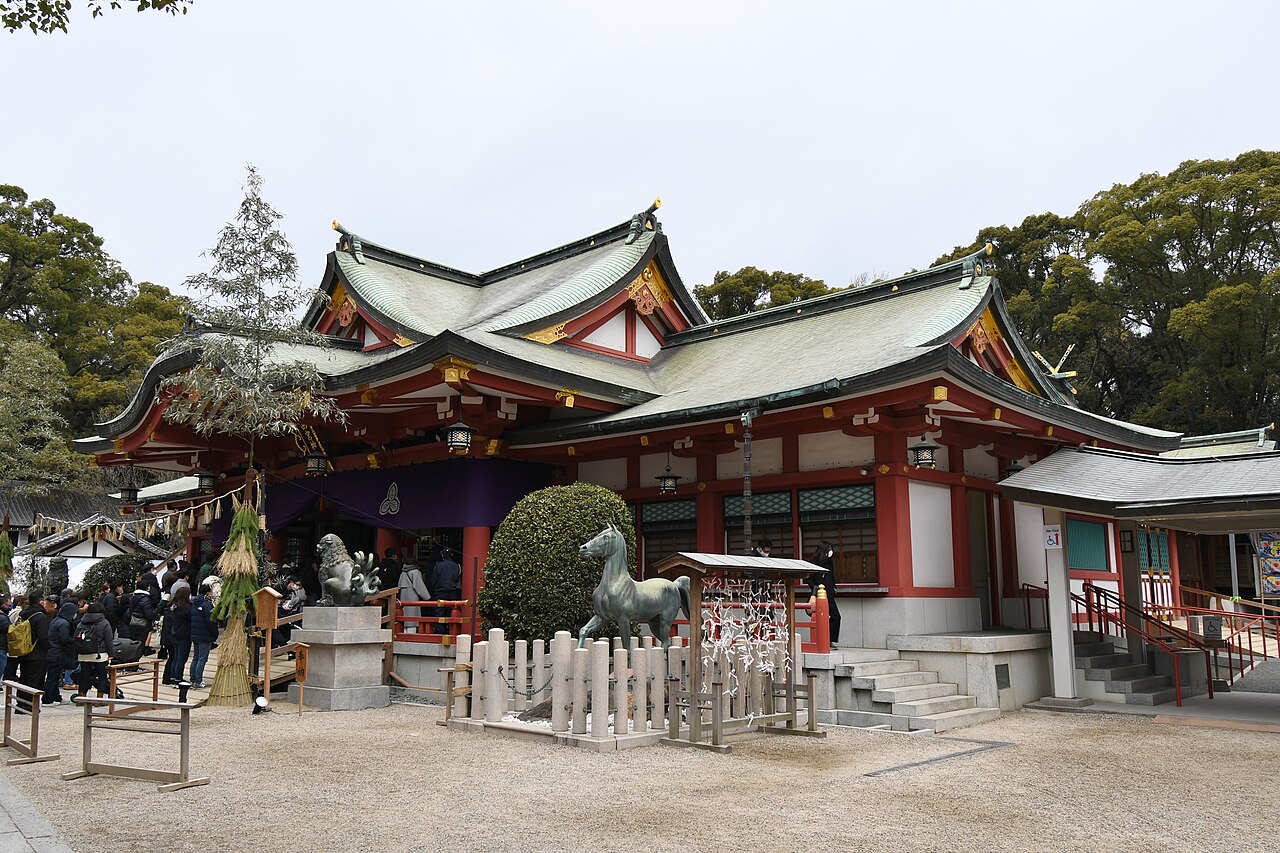
Nishinomiya Shrine
Nishinomiya Ebisu · Nishinomiya Jinja · 西宮神社
overview
What this place is
Nishinomiya Shrine in Nishinomiya, Hyogo Prefecture, is the head shrine of some three thousand Ebisu shrines across Japan. Its main building has three sanctuaries: Ebisu-no-Okami in the first, Amaterasu-Omikami and Okuninushi-no-Okami in the second, and Susanoo-no-Okami in the third. The main hall of 1663 burned in the war of 1945 and was rebuilt in 1961; the three-part building and its wings were registered as national cultural properties in February 2025.
- A main building of three linked sanctuaries in the kasuga style, registered as a national cultural property in 2025
- The Ebisu faith exhibition room, showing the puppets and printed images that carried the faith across Japan
- Ebisu-no-Mori, a grove in the north-west of the grounds designated a prefectural natural monument
- The opening-gate rite of the New Year, in which the first three runners are recognised as fukuotoko
plan your visit
Visit facts for Nishinomiya Shrine
- Access
- About 170 minutes from Tokyo Station by Shinkansen to Shin-Osaka and on by JR and Hanshin lines to Nishinomiya Station, then about 5 minutes on foot south-west from the Ebisu-guchi exit. It is about 10 minutes on foot from JR Sakura-Shukugawa Station.
- Nearest station
- Nishinomiya Station (Hanshin Main Line)
- Hours
- The gates are open from 5:00 to 19:00 from April to August, from 5:00 to 18:00 from October to February and from 5:00 to 18:30 in March and September. The amulet office is open from 9:00 to 17:00, prayer reception until 16:30 and the exhibition room from 9:00 to 16:00.
- Fees
- No admission fee for ordinary worship or for the exhibition room is published. An individual prayer service is from 5,000 yen and one for a company or group from 20,000 yen. A goshuin is 300 yen and the business amulet 800 yen.
- Parking
- Available in Japanese only: 公式は境内西南に駐車場があると案内していますが、台数と通常料金を掲載しておらず、祭典等で駐車できない場合があります。2026年7月20日は16:00以降、境内へ車で出入りできません。十日えびす等の大祭では通常条件を前提にせず、公共交通、周辺規制、満車、閉門を直前確認し、門前・えべっさん筋で待機しません。
- Goshuin (seal stamps)
- A goshuin is 300 yen. The desk and its hours follow the amulet office, generally 9:00 to 17:00, and change on the days of the great festivals.
- Typical visit
- About 75 minutes (Unmeguri's estimate, not an official figure)
- Facts checked
- 2026-10-22
background
Enshrined deities
Ebisu-no-Okami (Hiruko-no-Okami) · Amaterasu-Omikami · Okuninushi-no-Okami · Susanoo-no-Okami
The main building has three sanctuaries, with Ebisu-no-Okami in the first, Amaterasu-Omikami and Okuninushi-no-Okami in the second and Susanoo-no-Okami in the third. The official history describes Ebisu-no-Okami as a deity of fishing, of good catches and of safety at sea whose worship widened, as Nishinomiya became a post town with a market, to the market and to prosperity in trade.
etiquette
Visiting with respect
- Bow lightly once before passing through the torii gate, and rinse your hands at the water basin before approaching the hall.
- The faith in prosperity in trade is not an assurance about sales, contracts, hiring, investment or a lottery; check figures and contracts with the documents and with a professional.
- The opening-gate rite runs on a set day under its own rules; do not run, cut corners or overtake other worshippers on an ordinary day in order to repeat it.
- The name fukuotoko belongs to that rite and its first three runners; it says nothing about the fortune of anyone else, and a visit without running is complete.
- Do not touch, climb or lean on the sacred horse, the guardian lions, the fortune racks, the halls, the curtains or the New Year decorations.
- Do not photograph other worshippers, priests, children, written wishes or goshuin books without consent, and do not block the queue or the side route.
- At the lantern night in summer, keep clear of the candles and the fires used in the rites, and mind your clothes, hair and bags in the dark.
- Hours, fees and reception can change; check the official information before you go.
faq
Common questions
How do I get to Nishinomiya Shrine?
About 170 minutes from Tokyo Station by Shinkansen to Shin-Osaka and on by JR and Hanshin lines to Nishinomiya Station, then about 5 minutes on foot south-west from the Ebisu-guchi exit. It is about 10 minutes on foot from JR Sakura-Shukugawa Station. Nearest station: Nishinomiya Station (Hanshin Main Line).
How much does it cost to visit Nishinomiya Shrine?
No admission fee for ordinary worship or for the exhibition room is published. An individual prayer service is from 5,000 yen and one for a company or group from 20,000 yen. A goshuin is 300 yen and the business amulet 800 yen.
What are the opening hours of Nishinomiya Shrine?
The gates are open from 5:00 to 19:00 from April to August, from 5:00 to 18:00 from October to February and from 5:00 to 18:30 in March and September. The amulet office is open from 9:00 to 17:00, prayer reception until 16:30 and the exhibition room from 9:00 to 16:00.
Is there parking at Nishinomiya Shrine?
Parking information for Nishinomiya Shrine is available in Japanese only: 公式は境内西南に駐車場があると案内していますが、台数と通常料金を掲載しておらず、祭典等で駐車できない場合があります。2026年7月20日は16:00以降、境内へ車で出入りできません。十日えびす等の大祭では通常条件を前提にせず、公共交通、周辺規制、満車、閉門を直前確認し、門前・えべっさん筋で待機しません。
How long should I spend at Nishinomiya Shrine?
Unmeguri's estimate for a visit is about 75 minutes. This is an editorial estimate, not an official figure.
Can I get a goshuin at Nishinomiya Shrine?
A goshuin is 300 yen. The desk and its hours follow the amulet office, generally 9:00 to 17:00, and change on the days of the great festivals.
What is Nishinomiya Shrine known for?
It is the head shrine of the Ebisu shrines, known for the Toka Ebisu festival in January and for the opening-gate rite in which the first three runners are recognised as fukuotoko.
sources
Sources and checked dates
- えびす宮総本社 西宮神社 公式サイト(opens in a new tab)
- 西宮神社について(opens in a new tab)
- アクセス・参拝時間|西宮神社(opens in a new tab)
- 本殿|西宮神社(opens in a new tab)
- 境内案内一覧|西宮神社(opens in a new tab)
- ご祈祷|西宮神社(opens in a new tab)
- 商売繁盛・家内安全のご祈祷|西宮神社(opens in a new tab)
- 授与品|西宮神社(opens in a new tab)
- えびす信仰資料展示室|西宮神社(opens in a new tab)
- 令和8年 夏えびす|西宮神社(opens in a new tab)
- 開門神事の歴史|西宮神社(opens in a new tab)
- 西宮神社 えべっさん 開門神事福男選び|西宮市(opens in a new tab)
Facts last checked on 2026-10-22. Sources are in Japanese. Unmeguri separates officially documented facts from its own editorial reading, and does not promise that any wish or outcome will be realized.