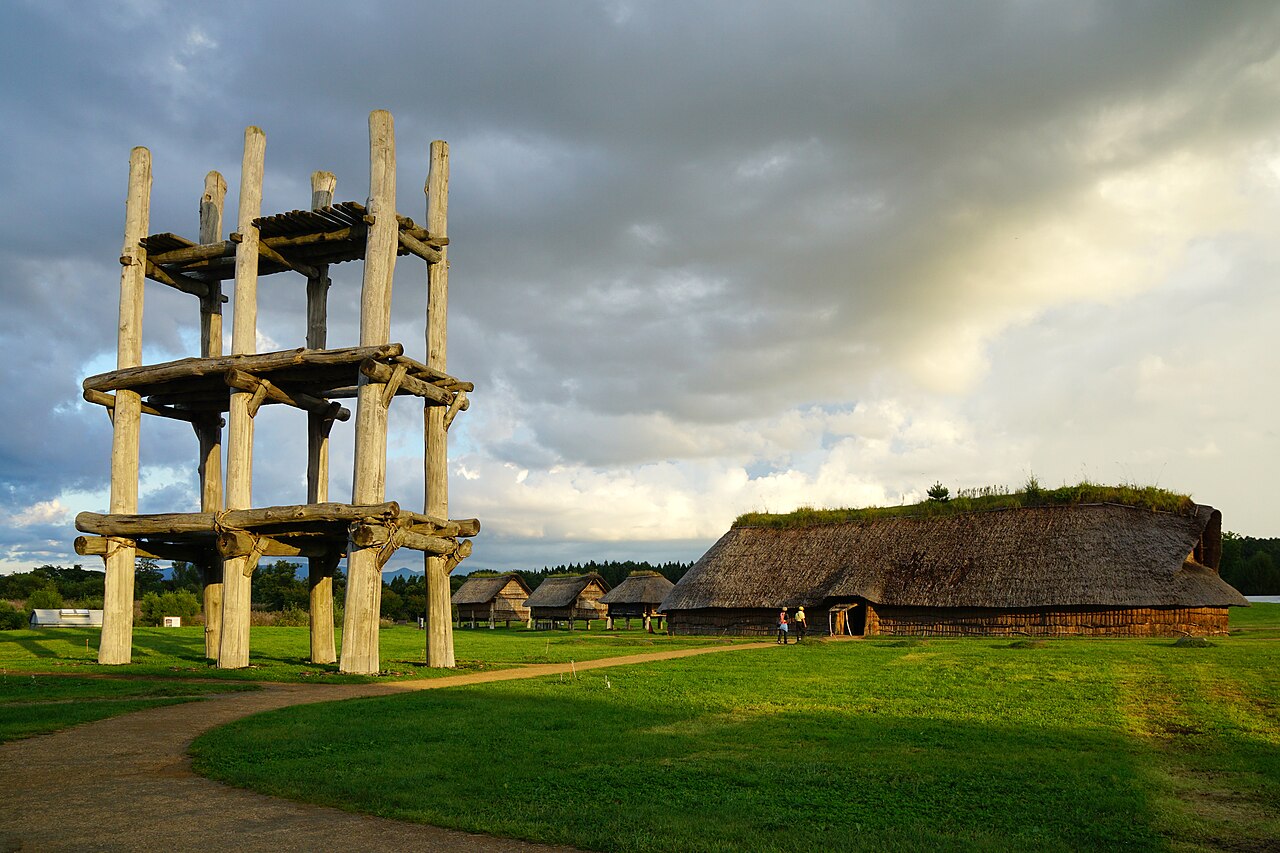
Sannai-Maruyama Site
Sannai Maruyama · Jomon site · 三内丸山遺跡
overview
What this place is
The Sannai-Maruyama Site in Aomori is a large Jomon settlement of the early to middle Jomon period, a special historic site and part of the Jomon prehistoric sites in northern Japan. It is not a religious site: what is shown here is how people lived, how they buried their dead, how they stored food, what they built and whom they traded with. Excavation from 1992 confirmed dwellings, graves and storage pits.
- A large settlement of the early to middle Jomon period
- Dwellings, graves and storage pits confirmed by excavation from 1992
- Some 2,000 items designated important cultural properties
- Reconstructed buildings on the site, beside the Jomon Jiyukan museum
plan your visit
Visit facts for Sannai-Maruyama Site
- Access
- About 30 minutes from JR Aomori Station by city bus to the Sannai-Maruyama Iseki-mae stop, then a minute on foot. Check how often the bus runs and the closing days.
- Nearest station
- Sannai-Maruyama Iseki-mae bus stop (Aomori city bus)
- Hours
- 9:00 to 17:00, and to 18:00 during Golden Week and from 1 June to 30 September. Entry is until 30 minutes before closing. It closes on the fourth Monday and on some other days.
- Fees
- 500 yen for adults, 250 yen for university students and the like, and free for high-school students and younger. Special exhibitions are charged separately.
- Parking
- Available in Japanese only: 大型駐車場あり。イベント時の交通案内を確認します。
- Typical visit
- About 100 minutes (Unmeguri's estimate, not an official figure)
- Facts checked
- 2026-10-22
background
Central feature
the remains of a large Jomon settlement · the finds and the reconstructed buildings
This is not a religious site. What is treated here is an archaeological site showing the life, the burials, the storage, the building and the exchange of the early to middle Jomon period.
etiquette
Visiting with respect
- The museum indoors and the site outdoors are separate choices; in a wheelchair or in bad weather the indoor part alone is a complete visit.
- The reconstructed buildings stand on an excavated site; keep to the paths and do not touch or climb on them.
- Graves were found here; treat the ground as a place where people were buried.
- Check the closing days before you travel, including the fourth Monday.
- Follow the notices on photography, which differ in the exhibition rooms.
- Hours, fees and reception can change; check the official information before you go.
faq
Common questions
How do I get to Sannai-Maruyama Site?
About 30 minutes from JR Aomori Station by city bus to the Sannai-Maruyama Iseki-mae stop, then a minute on foot. Check how often the bus runs and the closing days. Nearest station: Sannai-Maruyama Iseki-mae bus stop (Aomori city bus).
How much does it cost to visit Sannai-Maruyama Site?
500 yen for adults, 250 yen for university students and the like, and free for high-school students and younger. Special exhibitions are charged separately.
What are the opening hours of Sannai-Maruyama Site?
9:00 to 17:00, and to 18:00 during Golden Week and from 1 June to 30 September. Entry is until 30 minutes before closing. It closes on the fourth Monday and on some other days.
Is there parking at Sannai-Maruyama Site?
Parking information for Sannai-Maruyama Site is available in Japanese only: 大型駐車場あり。イベント時の交通案内を確認します。
How long should I spend at Sannai-Maruyama Site?
Unmeguri's estimate for a visit is about 100 minutes. This is an editorial estimate, not an official figure.
Is this a shrine or temple?
Neither. It is an archaeological site of the Jomon period, a special historic site and part of a World Heritage listing.
sources
Sources and checked dates
Facts last checked on 2026-10-22. Sources are in Japanese. Unmeguri separates officially documented facts from its own editorial reading, and does not promise that any wish or outcome will be realized.