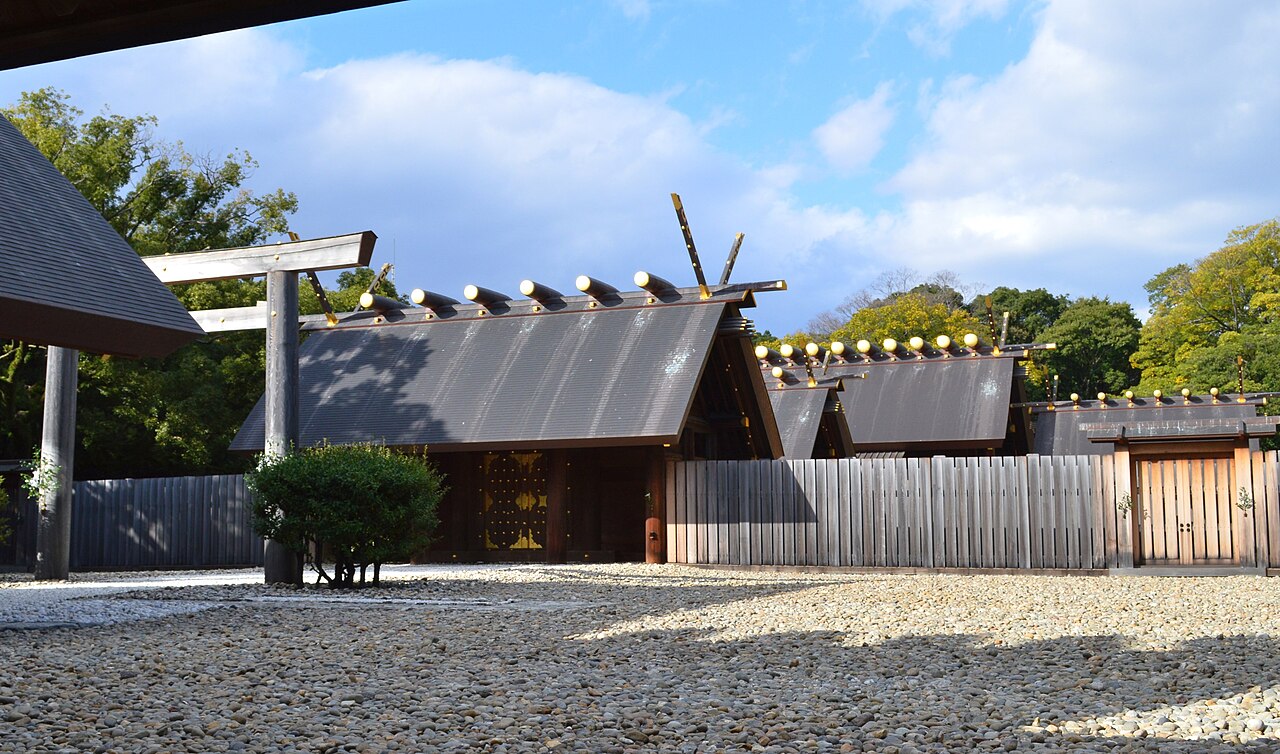
Atsuta Jingu Shrine
Atsuta Shrine · Atsuta Jingū · 熱田神宮
overview
What this place is
Atsuta Jingu stands in Atsuta Ward, Nagoya, in about 190,000 square metres of woodland with camphor trees estimated at around a thousand years old. It enshrines the Atsuta deity, Amaterasu Omikami as she dwells in the sacred sword Kusanagi-no-Mitsurugi, one of the three imperial regalia. The shrine relates that Yamato Takeru left the sword in Owari and that Miyasuhime-no-Mikoto enshrined it here, about 1,900 years ago.
- A main hall in the shinmei style, rebuilt in that form from 1893 and again in 1955 and 2009
- Woodland of about 190,000 square metres, with camphor trees estimated at around a thousand years old
- Historic structures in the grounds including the Nobunaga wall, the Sakuma lantern and the Nijugocho bridge
- The Kusanagikan sword museum, which shows swords offered to the shrine in rotation
plan your visit
Visit facts for Atsuta Jingu Shrine
- Access
- About 115 minutes from Tokyo Station by the Tokaido Shinkansen to Nagoya Station, then the Meitetsu, JR or subway lines, and about 3 minutes on foot from the station.
- Nearest station
- Jingumae Station (Meitetsu) / JR Atsuta Station / Atsuta Jingu-nishi and Atsuta Jingu Denmacho subway stations
- Hours
- The main hall can be visited at any hour. Tablets and amulets are given from about 7:00 until dusk, and prayer services are received on the day from 8:30 to 16:00. Car parks normally close at 17:00, so a night visit is not the same as full access.
- Fees
- Ordinary worship is free. An individual prayer service is 6,000 yen, 8,000 yen or from 10,000 yen, and from 10,000 yen for a party of five or more including family. Tablets, amulets and the two museums are charged separately.
- Parking
- Available in Japanese only: 参拝者駐車場は東門約300台、西門約40台、南門約60台の計約400台で、基本17:00閉門。祭典・初詣等で閉鎖や利用制限があり、24時間参拝できることは全駐車場を24時間使えることを意味しません。夜間参拝は公式FAQが西門駐車場を案内しています。
- Goshuin (seal stamps)
- The shrine issues a goshuin, which it calls goshin-in. Confirm the desk, the hours and the current amount on the day, and note that tablets and amulets are not normally sent by post.
- Typical visit
- About 70 minutes (Unmeguri's estimate, not an official figure)
- Facts checked
- 2026-10-22
background
Enshrined deities
The Atsuta deity (Amaterasu Omikami, dwelling in the sword Kusanagi-no-Mitsurugi) · Miyasuhime-no-Mikoto · Takeinadane-no-Mikoto
The Atsuta deity is Amaterasu Omikami as she dwells in Kusanagi-no-Mitsurugi, one of the three imperial regalia. The shrine relates that Yamato Takeru left the sword in Owari and that Miyasuhime-no-Mikoto, honouring his wish, enshrined it at Atsuta, which it dates to about 1,900 years ago. Five deities closely connected with the sword are enshrined alongside and are called the Goshin-sama; of these the shrine names Miyasuhime-no-Mikoto and Takeinadane-no-Mikoto, revered as distant ancestors of the Owari clan. The sword itself is not on display.
etiquette
Visiting with respect
- Bow lightly once before passing through the torii gate, and rinse your hands at the water basin before approaching the hall.
- Kusanagi-no-Mitsurugi is the vessel of the Atsuta deity; the swords shown at the Kusanagikan are offerings, not the sacred sword itself.
- The great camphor is described as planted by Kobo Daishi; look up at it rather than touching the roots, trunk or hollow, or leaving anything there.
- The prayers for victory associated with the Nobunaga wall are history, not an assurance about exams, elections or work; see it as an offering of its time.
- The main hall is open at any hour, but the amulet office, prayer services, museums and car parks keep their own times; do not enter closed areas at night.
- Worshipping only at the main hall, without an amulet, a prayer or a longer walk, is a complete visit.
- Hours, fees and reception can change; check the official information before you go.
faq
Common questions
How do I get to Atsuta Jingu Shrine?
About 115 minutes from Tokyo Station by the Tokaido Shinkansen to Nagoya Station, then the Meitetsu, JR or subway lines, and about 3 minutes on foot from the station. Nearest station: Jingumae Station (Meitetsu) / JR Atsuta Station / Atsuta Jingu-nishi and Atsuta Jingu Denmacho subway stations.
How much does it cost to visit Atsuta Jingu Shrine?
Ordinary worship is free. An individual prayer service is 6,000 yen, 8,000 yen or from 10,000 yen, and from 10,000 yen for a party of five or more including family. Tablets, amulets and the two museums are charged separately.
What are the opening hours of Atsuta Jingu Shrine?
The main hall can be visited at any hour. Tablets and amulets are given from about 7:00 until dusk, and prayer services are received on the day from 8:30 to 16:00. Car parks normally close at 17:00, so a night visit is not the same as full access.
Is there parking at Atsuta Jingu Shrine?
Parking information for Atsuta Jingu Shrine is available in Japanese only: 参拝者駐車場は東門約300台、西門約40台、南門約60台の計約400台で、基本17:00閉門。祭典・初詣等で閉鎖や利用制限があり、24時間参拝できることは全駐車場を24時間使えることを意味しません。夜間参拝は公式FAQが西門駐車場を案内しています。
How long should I spend at Atsuta Jingu Shrine?
Unmeguri's estimate for a visit is about 70 minutes. This is an editorial estimate, not an official figure.
Can I get a goshuin at Atsuta Jingu Shrine?
The shrine issues a goshuin, which it calls goshin-in. Confirm the desk, the hours and the current amount on the day, and note that tablets and amulets are not normally sent by post.
Can I see the sacred sword?
No. Kusanagi-no-Mitsurugi is the vessel of the deity and is not displayed. The Kusanagikan shows swords that have been offered to the shrine.
sources
Sources and checked dates
- 熱田神宮について|熱田神宮(opens in a new tab)
- 境内案内|熱田神宮(opens in a new tab)
- 本宮|熱田神宮(opens in a new tab)
- 御参拝・御祈祷|熱田神宮(opens in a new tab)
- 各種祈祷|熱田神宮(opens in a new tab)
- 御札・お守り|熱田神宮(opens in a new tab)
- アクセス・駐車場|熱田神宮(opens in a new tab)
- よくあるご質問|熱田神宮(opens in a new tab)
- 剣の宝庫 草薙館|熱田神宮(opens in a new tab)
- ご神印について(御朱印)|熱田神宮(opens in a new tab)
- 熱田神宮|名古屋市公式観光情報(opens in a new tab)
Facts last checked on 2026-10-22. Sources are in Japanese. Unmeguri separates officially documented facts from its own editorial reading, and does not promise that any wish or outcome will be realized.